
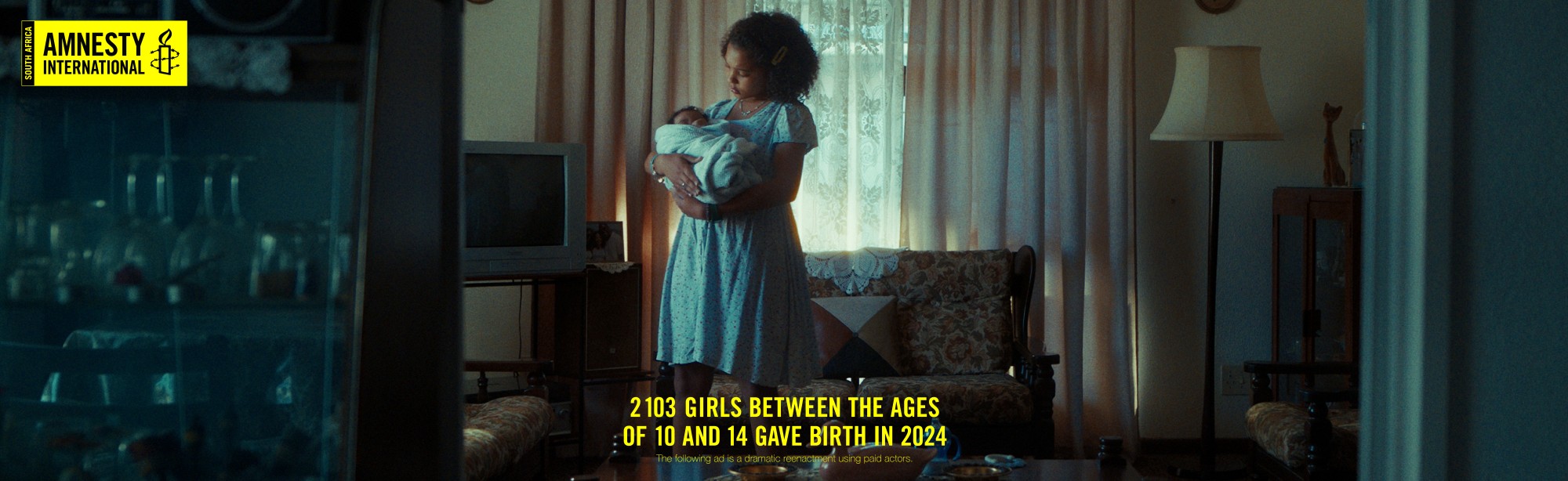
Preteen girls shouldn’t be singing to their own babies.


In South Africa, girls as young as 10 are singing lullabies to babies they were never old enough to have. Amnesty International’s latest “Lullaby” campaign confronts the reality of the rise in children raising children.
Unfortunately, public outrage only erupts when Christmas and New Year’s baby stories reveal that some of the mothers are children themselves. So Amnesty International and Joe Public decided to confront the matter head on. Lullabies are one of the first acts of love many of us experience as children. They represent safety, comfort, motherhood, and childhood itself. In each film, a young girl softly sings a lullaby as we move through her childhood home. By the end of the film, we discover the child is singing the lullaby to her own baby.
“By placing this familiar ritual in the hands of a child who should still be receiving it, we hope to expose the disturbing reality that 2103 girls between the ages of 10 and 14 gave birth in 2024,” says Amnesty International Director Shenilla Mohamed. “Most of these girls are forced to drop out of school or fall behind with their schoolwork. They become trapped in a cycle of poverty, leaving them dependent on public assistance, suffering the stigma of being pregnant and giving birth at a young age, or being forced into early marriages.”
Children do not have the capacity to consent to sexual activity, and sex with a child under 12 is always considered rape. Hidden behind closed doors and often accepted as someone else's problem, the issue is not being treated with the urgency it desperately deserves. To bring it to life, a whole team contributed their skills free of charge, including director Justice Mukheli of Romance Films.
Martin Schlumpf, Joe Public ECD, adds: “We wanted to take something universally gentle and turn it into a mirror that reflects a reality we’ve become far too comfortable overlooking – children being forced into adulthood far too soon. Justice brought a deeply human, restrained visual language to the films, capturing intimate moments with empathy and stillness that allows the reveal to land with real emotional impact, rather than feeling forced.”
Child and teenage pregnancy in South Africa is driven by factors such as poverty, poor access to contraceptives, gender inequalities, sexual taboos, high levels of gender-based violence, and inadequate sex education. The issue needs to be addressed by society and the government, but ultimately the state has a responsibility for the systemic failure; of education policy, health services, child protection, and the criminal justice response to gender-based violence.
To find out more and to take action, visit https://amnesty.org.za/


